The Complete Newborn Paperwork Checklist (2026)
Published June 24, 2026
Bringing a baby home is wonderful — and then the paperwork starts. Between feedings and not nearly enough sleep, new parents are expected to file a surprising amount of government and insurance paperwork, often on tight deadlines. This newborn paperwork checklist walks through everything you need to handle after birth, in the order it usually happens, so nothing slips through the cracks.
The 5 documents every new parent has to handle
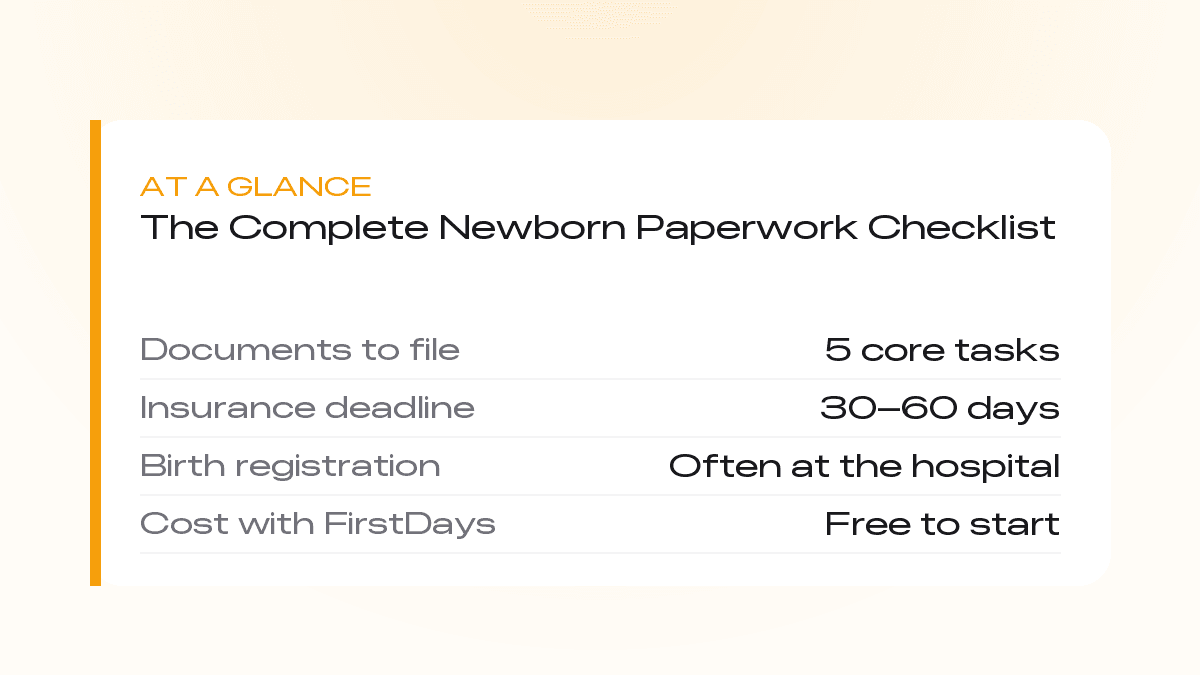
Almost every U.S. family deals with the same five tasks after a birth. A few are started for you at the hospital; the rest are on you and your partner.
1. Birth certificate
Your baby's birth certificate is the foundational document — you'll need it for the Social Security card, insurance, and eventually a passport. Good news: many hospitals register the birth for youright in the delivery unit, and the certificate is mailed to you a few weeks later. If yours doesn't, you'll order it from your state's vital records office. See our state-by-state birth certificate guides for the exact agency and fee where you live.
2. Social Security number
Your newborn needs a Social Security number (SSN) for taxes, insurance, and benefits. The easiest path is to apply at the hospital during birth registration — you opt in and they submit Form SS-5 with the birth record. The card arrives by mail, free of charge.
3. Add the baby to health insurance
This is the deadline that bites people. A birth is a qualifying life event, which opens a special enrollment window — typically about 30 days for an employer plan and 60 days for a marketplace plan. Miss it and your baby could be uninsured until the next open enrollment.
4. Choose and register a pediatrician
Most hospitals ask for your chosen pediatrician before discharge, and the first visit is usually 2–5 days after you go home. Picking one before your due date saves a scramble.
5. File parental leave paperwork
Between FMLA, your employer's policy, and (in some states) paid family leave, there are forms to file and notice periods to hit. Starting early protects both your job and your income.
The one deadline you can't miss
What's handled at the hospital vs. what's on you
A lot of parents are surprised by how much the hospital handles. In most delivery units a birth registrar (often part of the medical-records or health-information office) will:
- Register the birth with the state — which produces the birth certificate.
- Submit the Social Security number application if you opt in.
- Send your baby's records to the pediatrician you name.
What's still on you: adding the baby to insurance, finalizing leave paperwork with HR, and ordering extra certified copies of the birth certificate if you need them.
A simple timeline
- Before birth: choose a pediatrician, review your leave policy, confirm your insurer's add-a-dependent rules.
- At the hospital: complete birth registration and opt in to the SSN application.
- First 2 weeks: watch for the SSN card and birth certificate by mail.
- Within 30–60 days: add the baby to your health insurance.
- Per your employer's rules: submit parental leave paperwork.
Key takeaways
- There are five core post-birth tasks: birth certificate, SSN, insurance, pediatrician, and leave.
- The hospital often handles birth registration and the SSN application for you.
- Adding your baby to insurance is the deadline most parents miss — usually 30–60 days.
- Choosing a pediatrician before delivery avoids a discharge-day scramble.
Want this turned into a personalized, deadline-aware checklist for your exact state — with reminders before every window closes? Build your free checklist in a couple of minutes.
Get your personalized checklist — free
FirstDays builds a deadline-aware checklist for your state, reminds you before every window closes, and drafts the letters and forms for you. Free to start.
Build my checklist →