How to Add Your Newborn to Health Insurance
Published June 25, 2026
Of all the post-birth paperwork, adding your baby to health insuranceis the one with real money on the line. A newborn has medical visits almost immediately, and if you miss the enrollment window, you could be paying out of pocket — or have an uninsured baby until the next open enrollment. Here's how the process works and how to do it on time.
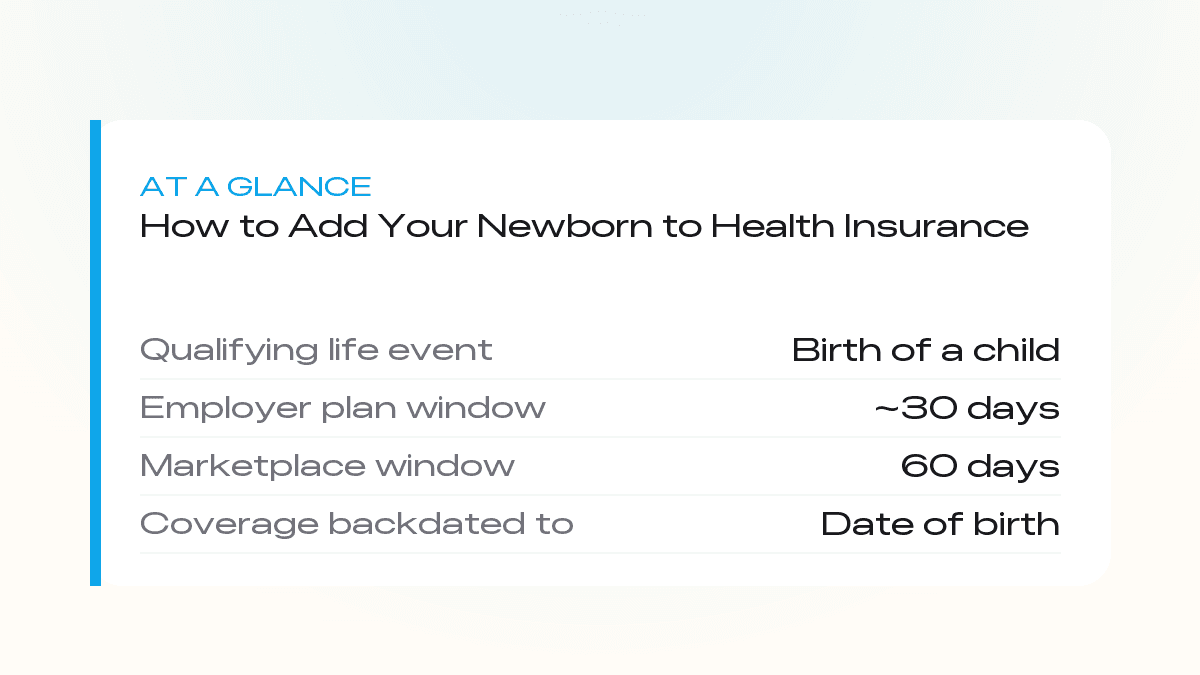
A birth is a "qualifying life event"
You normally can only change health coverage during open enrollment. But certain life changes — including the birth or adoption of a child — trigger a special enrollment period. That's your window to add the new dependent outside of open enrollment.
How long do you have?
- Employer plan: typically about 30 days from the date of birth (check your plan's exact rule — some allow more).
- Marketplace plan (Healthcare.gov or a state exchange): 60 days from the birth.
- Medicaid / CHIP: you can apply year-round; children are often eligible even when parents aren't.
Coverage is usually backdated
How to actually enroll your baby
If your coverage is through an employer
This is where many parents go wrong: you don't use Healthcare.gov. You add your baby through your employer's benefits portal or by contacting HR. The steps are usually:
- Log in to your benefits portal (or email HR) and start a "life event" / "add a dependent" change.
- Enter the baby's name and date of birth.
- Provide the Social Security number and/or birth certificate when you have them (you can often start without and add later).
- Choose the plan tier — note your premium will go up once a dependent is added.
If you have a marketplace plan
Report the birth to your marketplace (Healthcare.gov or your state exchange) and update your application to add the child. You have 60 days, and you may qualify for more financial help with a larger household. Our state guides link the right marketplace for your state.
What you'll need
- Baby's legal name and date of birth.
- Baby's Social Security number (or proof you've applied) — see our SSN guide.
- The birth certificate, in some cases — see how to get a birth certificate.
Key takeaways
- A birth is a qualifying life event that opens a special enrollment window.
- Employer plans usually give ~30 days; marketplace plans give 60 days.
- Employer coverage is added through your benefits portal or HR — not Healthcare.gov.
- Coverage is typically backdated to the birth date, and your premium will increase.
FirstDays tracks your insurance deadline from the day your baby is born and reminds you before it closes — plus it drafts the enrollment notice for you. Start free.
Get your personalized checklist — free
FirstDays builds a deadline-aware checklist for your state, reminds you before every window closes, and drafts the letters and forms for you. Free to start.
Build my checklist →